Brand = culture
[Cache #260]
Introducing the one-second, one-word employee engagement test.
In a past hospitality job, decades ago, I remember a colleague explaining to a customer that they were not going to get exactly what they wanted.
My colleague (let’s call him Bob) framed it as an unfortunate result of a decision that “they” – meaning management – had made.
I remember thinking that Bob using “they” – blaming the problem on someone else – was a cop-out. That instead, using “we” would have at least shown he was reasonably engaged with his job.
“We,” of course, is not the highest ground. “I” is.
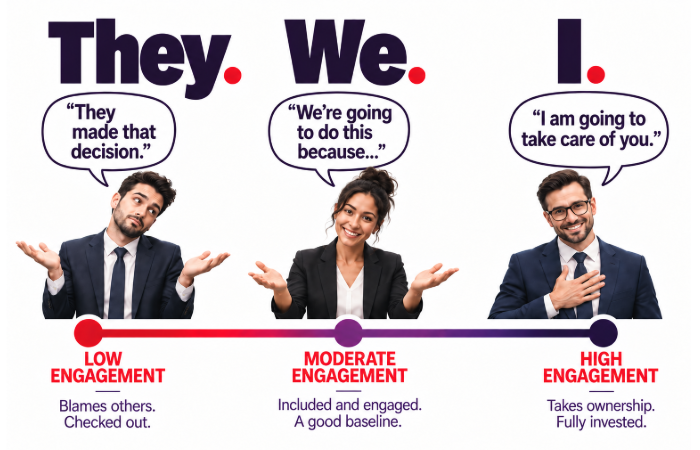
They – we – I. Consider it an employee engagement continuum.
If your team members are using “they,” they’ve either never bought in to what you’re doing, or have checked out.
If your team is using “we,” they are at least moderately engaged. And yet, “we” should be the minimum standard, because “they” is, well, bad.
All of this came to mind when I was getting my teeth cleaned earlier this month. The hygienist said, “I am going to do such-and-such because I don’t want such-and-such to happen to your teeth.”
She is not the dentist (wow…if there was ever a moment to run, it is your dentist using “they”). She is not the business owner. She is a dental hygienist taking ownership of her clients and I have to tell you, it felt very reassuring. I know that she is totally locked in. So I will go back.
I especially notice the they – we – I continuum at restaurants. When you have a server say, “I have these specials today and I have these beers on tap,” you know you are in the hands of someone highly engaged in what they are doing and willing to take responsibility for the quality of your experience. It is much, much more common for servers to use “we” (or “they” when they are blaming the kitchen).
“I” is heard very rarely indeed.
Some 20 years ago, I was fortunate to do some consulting work for the original owners of beerbistro, a restaurant (still) at the corner of King and Yonge in downtown Toronto. They had a wide and very thoughtfully put-together beer list, the staff were extremely well-educated on beer, and beer was an ingredient in every food item on the menu. Master chef Brian Morin and his team were running a serious restaurant, and the customers were pouring in the door.
Two expressions from that engagement have stuck with me. First was a classic saying of Brian’s: “There’s a great idea in the bottom of every beer.”
This might explain why we drank beer during our meetings. I sipped.
The other expression came from a senior member of his team, who referred to some people – a very small group of people – as having “the hospitality gene.” These people, it was explained to me, are the rare individuals who are born to be in service roles, caring for others.
Most of us experience considerable stress when serving others. These folks experience none. To them it is all a great pleasure. I will never forget the sight of Dougal, who had been a doorman at the Royal York Hotel for more than 40 years when I worked there in the late 90s, giving someone directions for the millionth time, with an enthusiasm that suggested it was the first time he had ever heard the question. THAT is the hospitality gene.
People like Dougal are the people most likely to speak in the language of “I.” At worst, “we.” And “they”? Never.
How to get your team members saying “I”?
This is a complex question, and I am not an HR expert. My contribution from the branding perspective can be this:
Your brand is your culture. They are the same thing. The logic goes like this:
A brand is what people think of you – especially, what you and your team think of yourselves and how you accordingly behave. Thus your brand is your system of beliefs and behaviours, and thus it is your culture.
So follow these three steps:
1
Make ownership a defining feature of your culture by embedding it in your brand foundation (we create them btw), being the written-down elements that define at least your:
Brand Foundation elements
Core purpose — why you do what you do, instead of merely what you do.
Position — how you are genuinely different from other advisors.
Character — how your brand acts, sounds and looks.
Reasons to believe — the proof that you are every bit as exceptional as your brand says you are.
(I am not talking about making actual equity ownership a feature of your brand, although you could do that.)
2
Assuming you are the CEO of the business, give yourself the official or unofficial title of Chief Brand Officer, and accept responsibility for ensuring every day that your team deeply understands the importance of ownership. A simple, crucial thing you can do is to start every team meeting by doing a table read of your brand foundation.
3
Repeat.
P.S. There is more here on the importance of having a brand foundation.
—
I, not AI, wrote this.
Andris Pone, BA, MBA
President
Coin Branding Inc.
andris@coinbranding.com
1 416 560 0928
www.coinbranding.com